Opening Note for the Discussion
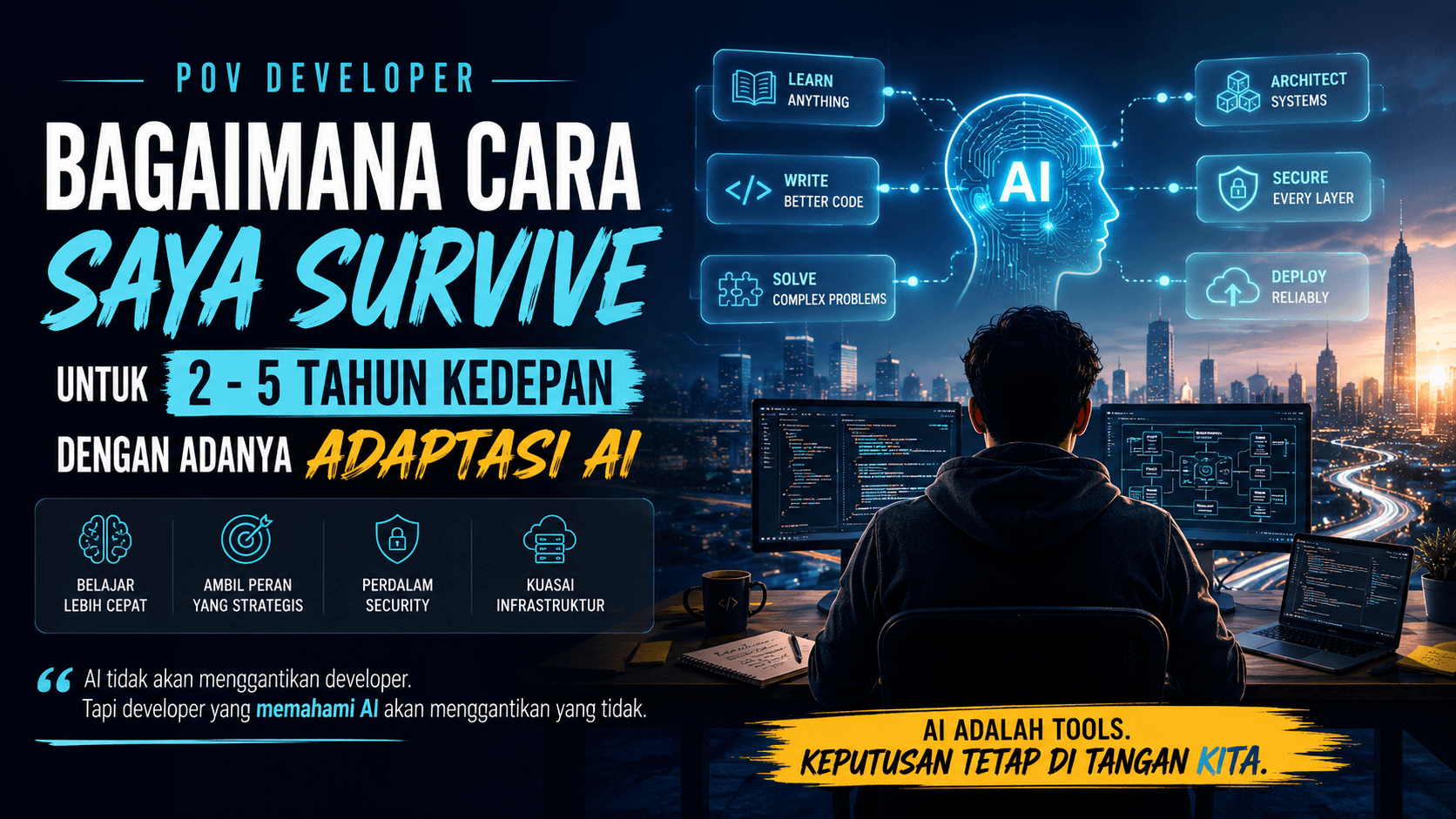
I wrote this article as a personal discussion note for my meeting with the CEO of PT Uniktif Media Indonesia on Friday, June 19, 2026.
The main question is simple, but important:
How can I survive for the next 2 to 5 years as a developer or software engineer in the middle of AI adoption?
For me, AI is not just a technology trend. AI is changing how we learn, work, make decisions, and build software.
From Books, to the Internet, to Communities, and Now AI
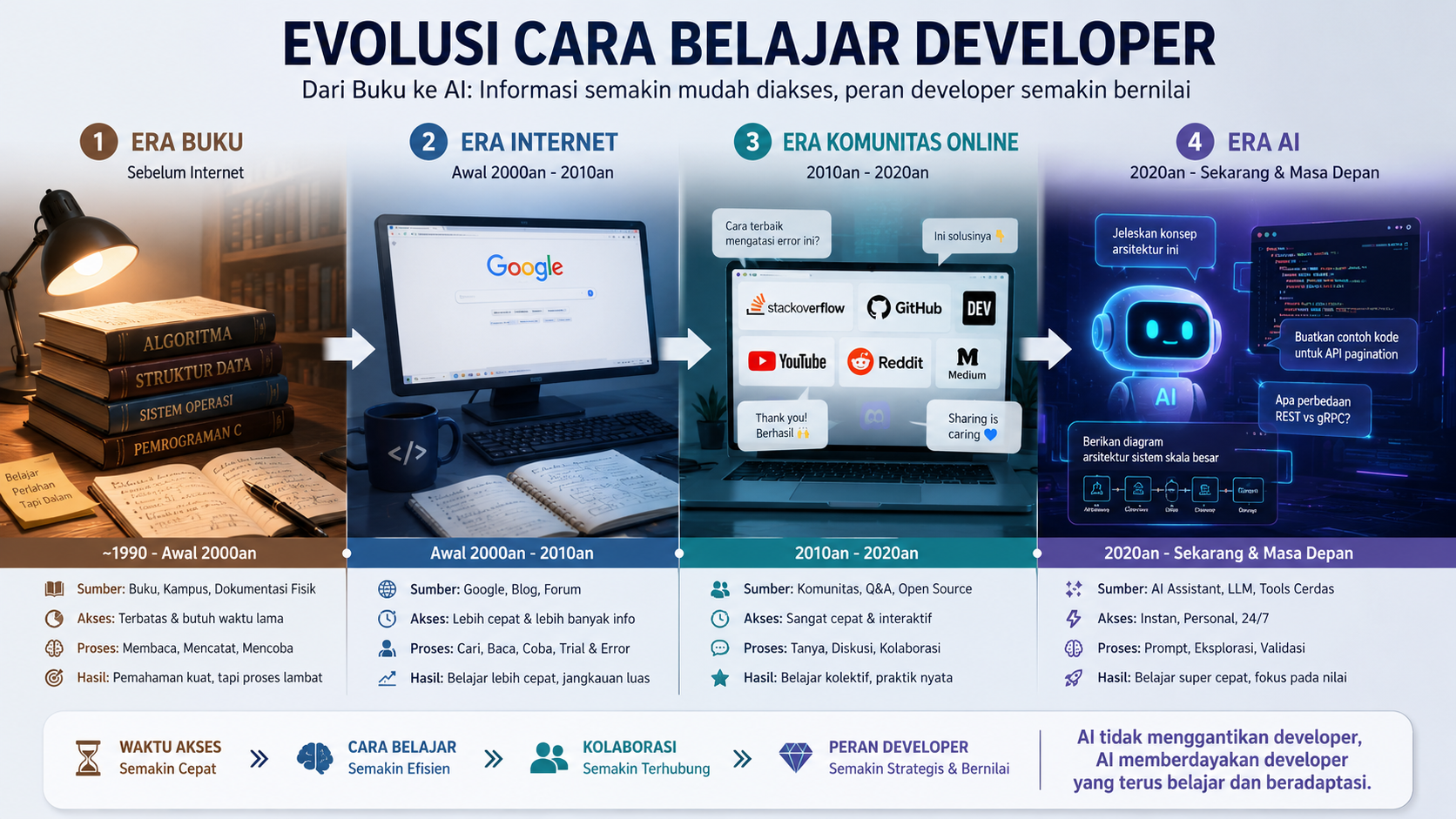
In the past, learning technology was much harder.
Information came from books, universities, thick documentation, or direct experience from senior engineers. Then the internet changed everything. Developers started learning from forums, blogs, Stack Overflow, GitHub, YouTube, and online communities.
Now we are entering a new era.
AI makes access to information faster than ever. We can ask questions, request code examples, compare solutions, find bugs, generate documentation, and understand difficult concepts with the right prompt.
Things that used to take days to understand can now be explored in hours.
The AI Dilemma: Helpful, But Risky for Thinking Skills
AI gives us a lot of convenience. But that convenience also creates a dilemma.
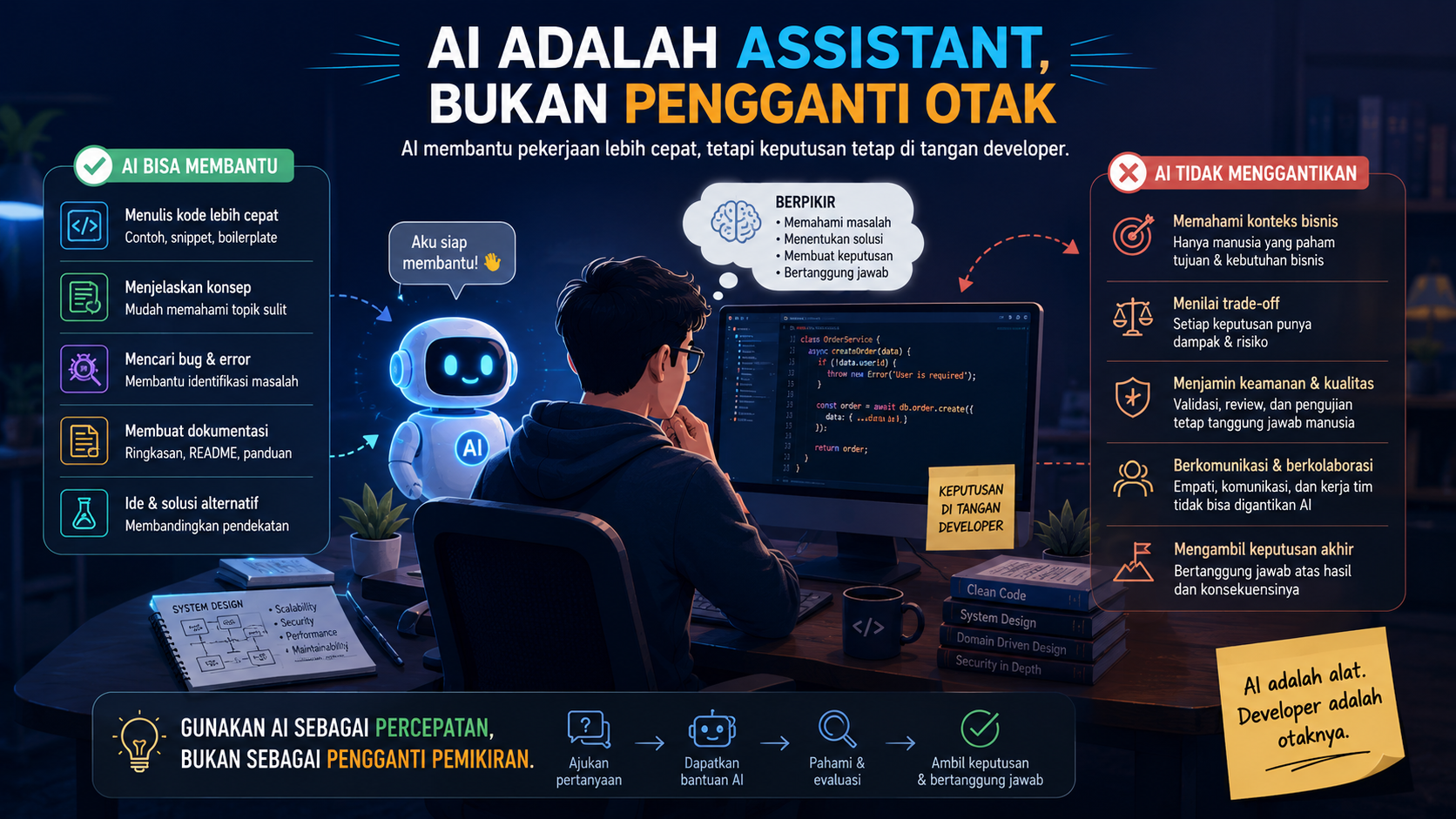
When every answer feels instant, there is a risk that organic thinking becomes weaker. Developers may accept answers too quickly without understanding the reason behind the solution.
That is dangerous.
In software engineering, the real problem is rarely only about “what code should I write”. The more important questions are:
- Why should this solution be chosen?
- Is this solution secure?
- Can this solution be maintained?
- Does this solution fit the business need?
- What is the long-term impact on the system?
AI can help write code. But developers still need to think, test, evaluate risks, and make decisions.
The Threat We Need to Admit
I do not want to ignore the threat.
Many technology leaders have said that AI will change programming jobs. Some predict that AI will be able to write most software code. Others say many jobs will be affected quickly.
This means developer work that only focuses on typing code will become easier to replace.
If my value is only “I can build CRUD”, “I can create endpoints”, or “I can follow tutorials”, then my position is fragile.
Because those tasks are becoming easier for AI to assist with.
My Perspective: AI Is a Chance to Level Up
I choose to see AI as an opportunity.
In the past, many things were difficult to learn because of limited time, access, and experience. Now, AI helps open many doors.
I can learn system architecture faster. I can compare backend approaches. I can understand security cases. I can ask about database design, deployment, observability, API design, and technical trade-offs more easily.
But my goal is not to become a developer who depends on AI.
My goal is to become a developer who can use AI to expand experience, speed up learning, and improve the quality of technical decisions.
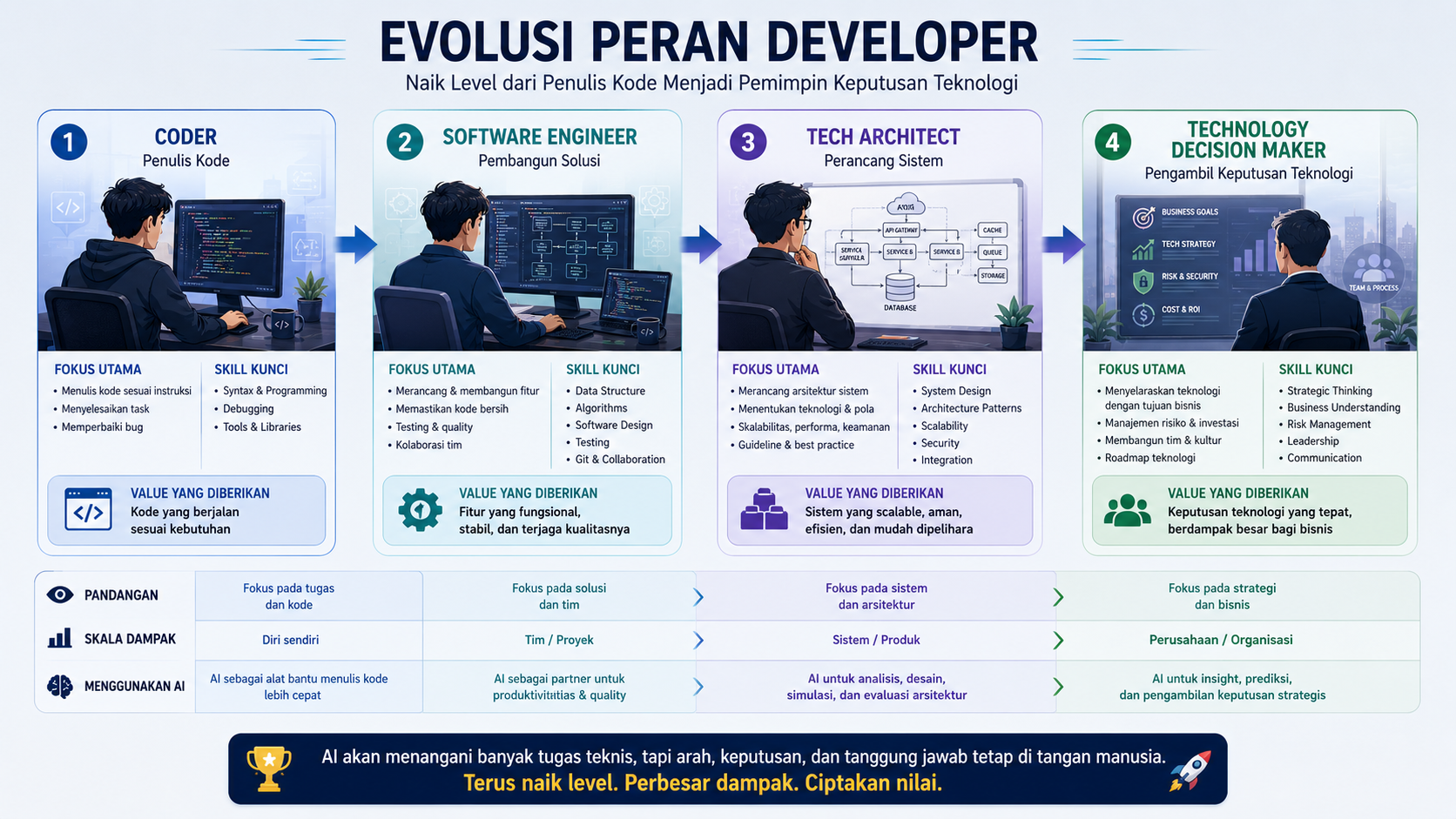
In other words, I want to move from only writing code to becoming a more mature technical decision maker.
The Roles I Want to Strengthen
To survive in the next 2 to 5 years, I need to grow into roles that are above basic AI capabilities.
Here are the areas I want to train.
1. Problem Framing
AI can answer questions. But humans need to define the right problem.
I need to get better at understanding business context, user needs, system limitations, and company priorities before choosing a technical solution.
2. Technical Decision Making
Not every solution that works in code is the right solution for the system.
I need to choose what is optimal, secure, simple, and realistic for the team.
3. System Architecture Instinct
I want to sharpen my instinct as a tech architect.
This means I should not only see a feature as an endpoint or a database table. I also need to understand data flow, scalability, security, frontend-backend integration, monitoring, deployment, and operational cost.
4. Code Validation
AI can generate code quickly. But I need to validate that code.
I must make sure AI-generated code is clean, secure, testable, not over-engineered, and does not create new problems.
Security Will Become a Critical Skill
In the AI era, security becomes even more important.
AI can help generate code, but it can also produce code that looks correct while hiding security risks.
For example:
- weak input validation
- database queries vulnerable to injection
- unsafe token or secret handling
- server configuration that is too open
- vulnerable dependencies
- error handling that leaks sensitive information
That is why I need to go deeper into security.
Not to become paranoid, but to build systems that are safer and more trustworthy.
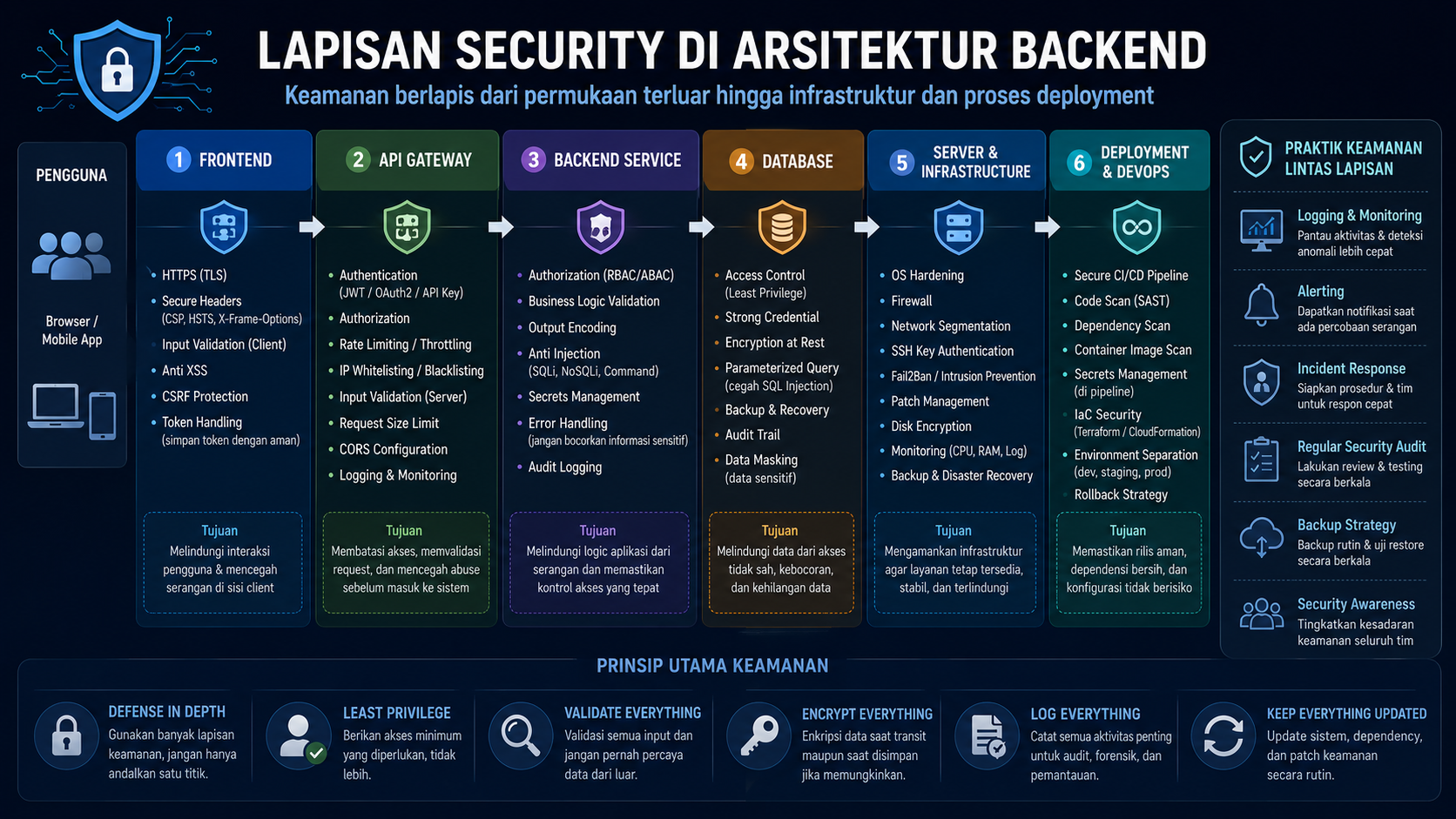
Infrastructure Still Needs Human Responsibility
AI can suggest configuration, commands, or deployment strategies.
But production infrastructure still needs human responsibility.
Servers, databases, domains, SSL, CI/CD, monitoring, backups, scaling, incident handling, and production access are not only technical matters. They are also business risks.
When a system goes down, data leaks, an API becomes slow, or a deployment fails, the company does not only need an AI answer. It needs a person who understands the context, can make decisions, and is willing to take responsibility.
This is where I see a big opportunity.
Developers who understand backend, security, and infrastructure will still have strong value.
My Strategy for the Next 2 to 5 Years
To survive, I need to move with more awareness.
My strategy is:
- use AI as a learning accelerator
- keep strengthening fundamentals
- go deeper into backend engineering
- improve security awareness
- understand system design and architecture
- become better at reading trade-offs
- build habits around validation, testing, and review
- understand deployment and infrastructure operation
- learn to see technology from a business perspective
With this strategy, I do not want to compete against AI.
I want to become the person who can guide AI to produce better work.
Conclusion
AI will change the developer profession. That is unavoidable.
But I believe developers will not lose their value if they are willing to level up.
For me, the way to survive is not to reject AI. The way to survive is to understand AI, use it, and strengthen the skills that AI cannot fully replace yet.
I want to become a developer who can do more than write code. I want to understand problems, choose solutions, protect security, manage infrastructure, and make technical decisions that create impact.
In the next 2 to 5 years, my biggest value will not only come from how fast I can code.
My biggest value will come from how well I think, how well I make decisions, and how well I use AI to build systems that are safer, more effective, and more valuable for the business.