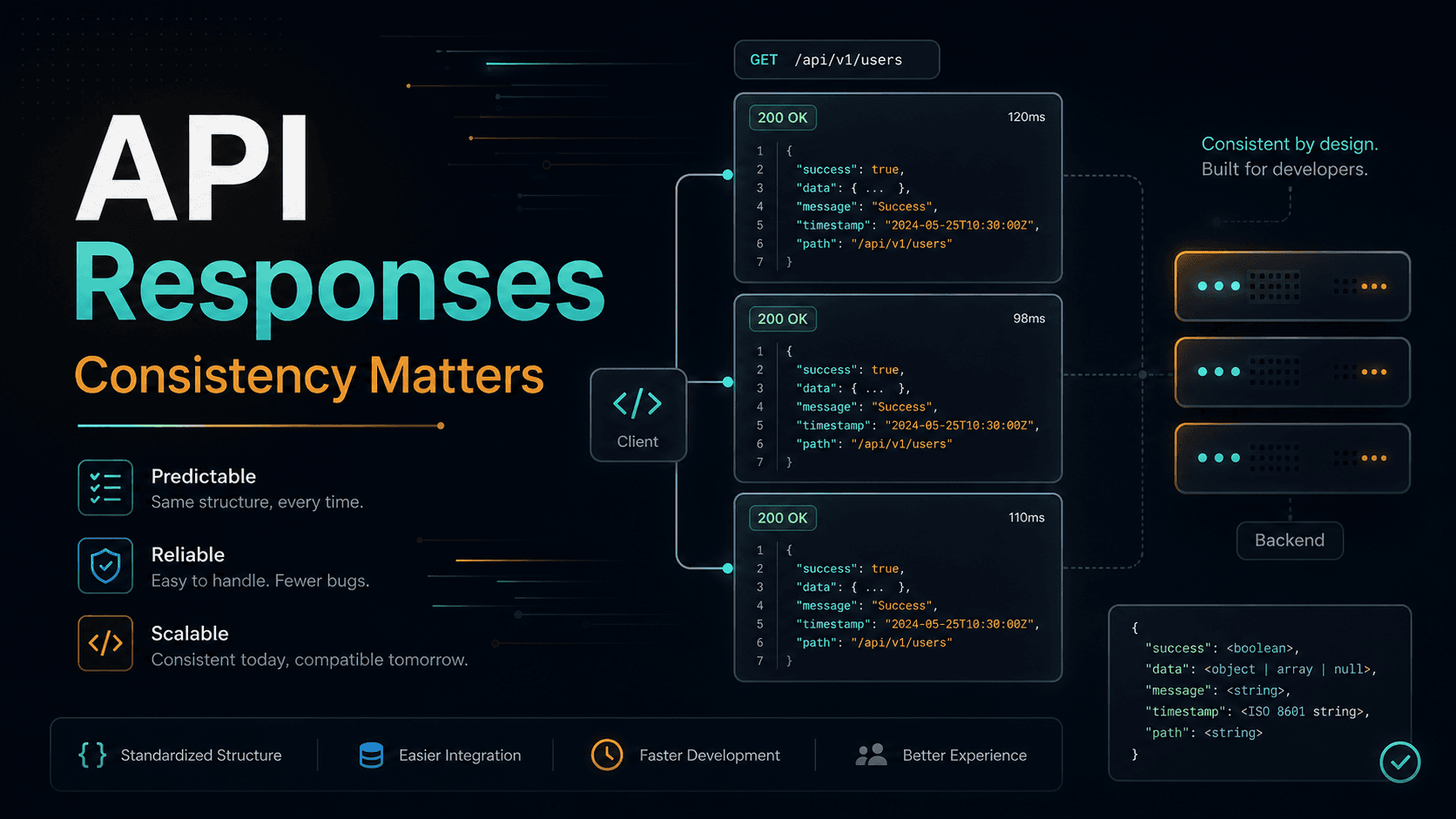
The Problem with Inconsistent API Responses
The frontend becomes harder to work with when each backend endpoint has a different response format. For example, one endpoint returns data directly, another uses message, and another has a different error structure.
This inconsistency forces the frontend to add many extra conditions just to read responses.
A Cleaner Response Format
A consistent response format usually includes status, message, and data.
Success response example:
{
  "status": true,
  "message": "Data retrieved successfully",
  "data": {}
}
Error response example:
{
  "status": false,
  "message": "Data not found"
}
Benefits for the Frontend
Easier Data Reading
The frontend can always check status first. If status is true, data can be used. If status is false, message can be shown to the user.
Simpler Error Handling
With the same response format, the frontend does not need different handlers for every endpoint.
Faster Integration
Frontend developers can understand the response pattern faster because all endpoints follow the same structure.
Benefits for the Backend
- Responses are easier to control.
- Errors are easier to trace.
- API documentation becomes cleaner.
- The service layer has a clear standard.
- Endpoint testing becomes easier.
HTTP Status Still Matters
Even though the response body has a status field, HTTP status codes are still important. For example:
- 200 for successful requests.
- 201 for successful creation.
- 400 for invalid requests.
- 401 for unauthorized access.
- 404 for data not found.
- 500 for server errors.
Conclusion
Consistent API responses make communication between backend and frontend clearer. With a status, message, and data pattern, the frontend can read responses more easily and the backend can maintain endpoint standards better.